Jackie Chan in Fists of Fire is a bizarre arcade fighting game from 1995, featuring digitized characters a la Mortal Kombat. It's easy to play, looks utterly ridiculous to bystanders, and has three different versions of Jackie Chan in the roster. It's one of my favorite fighting games, and it received the honor of having an impromptu tournament thrown for it at the big fighting game showdown we had down here in Denver the other day.
Fists of Fire is pure footsies. Jumps are hilariously floaty, but also dangerous. Getting hit in mid-air leads to knockdowns. Getting knocked down leads to you getting kicked repeatedly, or worse. By comparison, dashes are super fast and super safe, and can be ended at any time. The result: Jackie Chan Giga Footsies.
If it didn't look so absolutely ridiculous, I'd put this up there as one of the best beginner-level fighting games. Heck, let's do it anyway. Combos in this game are as simple as they get. You can chain 4 jabs together, end it with a special or super, kick the other guy three times while he's down and take off half a lifebar. If you can do a fireball in Street Fighter II, you can play this game.
The degree of visual incongruity is probably the best part, though. A roster consisting of three Jackie Chans, five random Mortal Kombat-kinda people in body paint and cheap costume, and Mysterious Dragon? FMV explosions that fill the screen at the end of a round? Throws that send people spinning end over end like a propeller? It's this close to being a pirate romhack, but... Oh, shit, nearly forgot: If the match is between two of the non-Jackie characters, there's gratuitous bloodshed and fatalities. As soon as Jackie enters the ring, though, the game turns PG. This is his game, after all. You think you're gonna tear Jackie's torso in half? Make him bleed? Aw hell naw. He's a great sport, though. Beat him (or, uh, lose as him) and he responds with a thumbs up every time.
Fists of Fire is MAME-only right now, which means it isn't supported by GGPO or Supercade. Considering the hype this game is building, however, something tells me that's bound to change.

Tuesday, February 2, 2010

Wednesday, January 6, 2010
'Perfect Nightmare' is Damn Right!
This time around, Jamaal checks out the demo for a new Western-developed visual novel, and finds that... yeah, it's not so good. Buckle up.
I had one helluva treat today. The kind of treat-- in this case a snack-- that your friend gives you, and they're SO eager for you to try it that you can't help but be suspicious. They hold out their hand to you, and in their palm is the treat of promised goodness. They smile grandly at you, but it's awkward... it's the kind of smile one has when holding back laughter. You're suspicious; you know something is wrong... but they're your friend, and you're theirs! And since we're all friends here, everything is all right... right?
So by whatever logic that lies dormant in our bodies to go through with stupid, obviously bad ideas, you partake of the treat your friend has offered you. You're a damn fool for doing as such, and your friend is smirking and laughing at your agony as this ass-flavored thing sits in your mouth. At this point, you can either spit out the so-called treat your friend gave you, or you can swallow your pride, and swallow it down (heh). Considering that I'm both a masochist and bursting with pride, one can assume my mouth is now filled with a flavor I can't wash out.
The treat my friend sent me this morning had attempts at appeal, and nothing but ass-flavor by the end. She links me to a forum thread that she had gotten from someone's Deviant-Art page. The information inside pertains to the creation of a visual novel called Perfect Nightmare: Overkill. One woman is taking it upon herself to make this happen: from the story, to the art, to the everything. It's all her.
Quite frankly, when I got to the characters section of the opening post, about half a screen worth of scrolling down, my brain was instantly deep fried in pure bullshit.

These characters were created in some kind of trans-hallucinogenic trip. Crazy colored eyes, super tie-dye hair, broken knees. You name it, they have it. You need a special kind of mind for "uniqueness" to create these abominations of man and woman! It's like driving past a high school when the kids are let out. All the variety in random BS fashion you'll see on those kids looks and feels a lot like these characters. Random... in an attempt to be one-of-a-kind.
"Well shit!" I think to myself. "I'm in too deep now." I stand from my computer chair and stretch, because I know I have to see what my friend is trying to Tom Fool down my throat. I'm a Visual Novel virgin, and I have a feeling I'm about to get raped. So against my better judgment, I download the demo of meager size, click to unzip, and launch that junk up.
As I mentioned, I've never actually played (would that be the proper term?) [Oh no you di'int! -Ed] a Visual Novel of any kind. I know of a few, but that's only because I've played their fighting game counterparts, like Fate/Unlimited Codes, based off of Fate/Stay Night, and Melty Blood, based off Tsukihime, just to name a few. So my thoughts and opinions may be brash, simple-minded, lacking in knowledge and overall ignorant. Frankly, I don't care, because it was all hella BS!

This is the first of the three main characters. This is also the first of three main characters I can't bring myself to care about. Getting done watching the news, The Mastermind pops her leg up, showing off her amazing (see: awful) frilly fashion. She is, as the name 'Mastermind' puts it, the supposedly super-smart head honcho of the group the game focuses on: the Night's Gale Guild.

And the guy conversing with her now is The Proxy (I'm reminded of Read or Die's code names here), a robot with Tourette's. Tourette's, a not-so-bad checkered shirt accompanied with a horrible purple turtleneck, and hair that Skittles would love to use for their advertisements. [I watched Demolition Man on laser disc over the holidays, and The Proxy is dressed just like 1996-era Wesley Snipes -Ed.]
Between these two characters, there is a recurring joke in which The Mastermind calls The Proxy "whore," and The Proxy calls The Mastermind "slut." It's not funny; I didn't even smirk or give it my usual "What the hell... Seriously?" response. It's not so bad that it's good. It's so bad you want to slam your head into the nearest solid object.
Actually, The Proxy doesn't actually have tourettes, but he might as well. He just fits 'fuck' into the most awkward and unnecessary moments. Like, check this situation out:

The game introduces this blonde gal, Female Marionette #2, the third main character. She is plagued with amnesia, and therefore a lot of mystery like every other character in this game. She's gonna be the character you're identifying with the most, I figure, as she knows as much as you do about anything going on in this damn world.
Still, The Mastermind asks the blonde gal to tell her what she's doing there, arguing with her amnesia, an argument fit only for a genius like her. But The Proxy shows back up, and not a moment too soon. "I thought you had work to do?!" asks the Mastermind, to which he responds:


So Female Marionette #2 is a traniee. The Mastermind doesn't know why they need her, because they already have two other marionettes. Well, because they're 'bloody troublemakers' as The Proxy puts it. "Good call," The Mastermind responds, the idea obviously never occurring to her. Despite being a "mastermind" of some kind, she has very little going for her. Both as a genius and as a character. She's done nothing important, or even interesting, up to this point besides unnecessary bitching.
Eventually you get a chance to ask some questions. Sadly, the answers barely make you give a damn. For a game so focused on story and development, there are less hooks than a goddamn fishing rod. Still, as a "reward," this gives The Proxy many opportunities to randomly insert "fuck" into his sentences.
Seriously. Here's a sample dialogue tree:
OKAY, WHAT? THE MASTERMIND IS A GUY? MORE LIKE MASTER-MAN. Maybe I'm just slow and I don't remember what males look like. No, screw that. He looks exactly like a girl!
Still... THE TWO CHARACTERS DON'T ACT LIKE THERE WASN'T ANY SORT OF POSSIBLE CONFUSION WITH THAT! I...just don't know... I feel dumb now... for reasons I can't even explain, honestly... Maybe it's an "I should have known" thing. Maybe I'd shaken and smacked my head so many times that brain damage occurred. Maybe it's just fucking stupid. Yeah, I agree: It's a mix of the last two.
Sigh... Playing-- or reading-- this game is work. Not like reading something informative, like a text book, where you get a return on your time investment. It feels like I have to force myself to continue reading after every word I lay my eyes on, just because it's that mind-numbing to me. And because this is a demo, or maybe because it's a Visual Novel, there is no light at the end of the tunnel. This 'game' is tiring out my brain. I wanna quit so badly, but...!

nah foo' u jus' some straight frontin' punk ass bitch.
This red-haired boy who has come under attack by ghosts seems to be the first side character. Obviously, he's helpless, and you get to choose to help him or not. Neither option seems to affect much in the game. Same with any of the other limited choices given to you in this demo. There goes what little excitement there could have been for the demo ... and probably the game.
I hate to admit it after struggling through the rest of the demo, but he might be the first character I have a chance of caring for... at least until the game is voiced-over'd as the creator has promised ("Oh god..." I know). His name is The Stellate, and he's a terrible, horrible wigga who won't think twice about pullin' no trigga. He even solidifies his position by saying he's a real gansta himself. He's teleports bitches and he's bad for your health!
...Unfortunately, he doesn't freestyle like that consistently.
So the modus operandi for the game, and the guild's next mission is now revealed, about twenty minutes into the demo, and less than five minutes from the end: To destroy the Earth! Even The Mastermind is taken aback by news of this! ...Though it's odd that he didn't know about it already. In fact, I realized something: In the text of the second image with The Proxy, he says The Mastermind should talk to the others about the task at hand. Yet, only now do they mention anything of a task, 25 minutes into the demo. What is up with the weird inconsistencies in this game?
Still, they can't possibly destroy the Earth! "They have cheese for fuck's sake!!" quoth The Mastermind. Ugh, really? This game demo is like 20 of the most unnecessary ways to use the word "fuck," followed by another "Slut", "Whore" moment, and there's been about four of these up to now so far. I haven't smiled in the slightest once, as the placement of the joke is extremely forced after the second time.
Of course, what creation by a female fan of anime wouldn't be complete without some girly men loving on each other? As Anime World Order's Daryl Surat put it in a recent episode, "maybe they're gay" remains a winning formula in manga and beyond. Despite being short-lived, it's still a selectable option, and there's probably plenty more to come.
To be fair, this is a demo. At its core, it's not at all a complete game. Sure, the last screen leaves you with a "To be continued...." but for me, there's very little to look forward to. Sure, it could turn out to be extremely awesome and creative for all that I know. It could have a juicy story with a shocking climax, and maybe even a lot of well-written dialogue! (Pffft...)
Despite being a demo, my first visual novel, and my ability to stay fair with all situations, I still remain extremely doubtful this is going anywhere. Regardless of what I think, most people on the forum seem to be genuinely interested in the game. Who am I to tell them they're wrong? Maybe they enjoy their weird characters, bad dialogue, and the fucked up use of curse words...
...They're lying to themselves, though. Hah!
I had one helluva treat today. The kind of treat-- in this case a snack-- that your friend gives you, and they're SO eager for you to try it that you can't help but be suspicious. They hold out their hand to you, and in their palm is the treat of promised goodness. They smile grandly at you, but it's awkward... it's the kind of smile one has when holding back laughter. You're suspicious; you know something is wrong... but they're your friend, and you're theirs! And since we're all friends here, everything is all right... right?
So by whatever logic that lies dormant in our bodies to go through with stupid, obviously bad ideas, you partake of the treat your friend has offered you. You're a damn fool for doing as such, and your friend is smirking and laughing at your agony as this ass-flavored thing sits in your mouth. At this point, you can either spit out the so-called treat your friend gave you, or you can swallow your pride, and swallow it down (heh). Considering that I'm both a masochist and bursting with pride, one can assume my mouth is now filled with a flavor I can't wash out.
The treat my friend sent me this morning had attempts at appeal, and nothing but ass-flavor by the end. She links me to a forum thread that she had gotten from someone's Deviant-Art page. The information inside pertains to the creation of a visual novel called Perfect Nightmare: Overkill. One woman is taking it upon herself to make this happen: from the story, to the art, to the everything. It's all her.
Quite frankly, when I got to the characters section of the opening post, about half a screen worth of scrolling down, my brain was instantly deep fried in pure bullshit.

There's something wrong with all three of these characters!
These characters were created in some kind of trans-hallucinogenic trip. Crazy colored eyes, super tie-dye hair, broken knees. You name it, they have it. You need a special kind of mind for "uniqueness" to create these abominations of man and woman! It's like driving past a high school when the kids are let out. All the variety in random BS fashion you'll see on those kids looks and feels a lot like these characters. Random... in an attempt to be one-of-a-kind.
"Well shit!" I think to myself. "I'm in too deep now." I stand from my computer chair and stretch, because I know I have to see what my friend is trying to Tom Fool down my throat. I'm a Visual Novel virgin, and I have a feeling I'm about to get raped. So against my better judgment, I download the demo of meager size, click to unzip, and launch that junk up.
As I mentioned, I've never actually played (would that be the proper term?) [Oh no you di'int! -Ed] a Visual Novel of any kind. I know of a few, but that's only because I've played their fighting game counterparts, like Fate/Unlimited Codes, based off of Fate/Stay Night, and Melty Blood, based off Tsukihime, just to name a few. So my thoughts and opinions may be brash, simple-minded, lacking in knowledge and overall ignorant. Frankly, I don't care, because it was all hella BS!


And the guy conversing with her now is The Proxy (I'm reminded of Read or Die's code names here), a robot with Tourette's. Tourette's, a not-so-bad checkered shirt accompanied with a horrible purple turtleneck, and hair that Skittles would love to use for their advertisements. [I watched Demolition Man on laser disc over the holidays, and The Proxy is dressed just like 1996-era Wesley Snipes -Ed.]
Between these two characters, there is a recurring joke in which The Mastermind calls The Proxy "whore," and The Proxy calls The Mastermind "slut." It's not funny; I didn't even smirk or give it my usual "What the hell... Seriously?" response. It's not so bad that it's good. It's so bad you want to slam your head into the nearest solid object.
Actually, The Proxy doesn't actually have tourettes, but he might as well. He just fits 'fuck' into the most awkward and unnecessary moments. Like, check this situation out:

Still, The Mastermind asks the blonde gal to tell her what she's doing there, arguing with her amnesia, an argument fit only for a genius like her. But The Proxy shows back up, and not a moment too soon. "I thought you had work to do?!" asks the Mastermind, to which he responds:

Classy! I mean, fuckin' classy!
And his awesome dialogue doesn't stop there. He just slams the word in wherever he wants, whatever the sentence! It feels like the writer is going for the "I don't give a damn" character, but cussing as spontaneously as he does accomplishes nothing.
That, and a lot of the dialogue feels unnecessary and not relevant to anything. Not humor, not character development. Just filler to pretend the game has more depth than it actually does. A 6 ft. depth sign in a 3 ft. depth pool sends you diving headfirst into a floor of concrete.

Yeah you guys! Stop! I don't give a damn about the arguing; I give a damn about the unnecessary dialogue!
So Female Marionette #2 is a traniee. The Mastermind doesn't know why they need her, because they already have two other marionettes. Well, because they're 'bloody troublemakers' as The Proxy puts it. "Good call," The Mastermind responds, the idea obviously never occurring to her. Despite being a "mastermind" of some kind, she has very little going for her. Both as a genius and as a character. She's done nothing important, or even interesting, up to this point besides unnecessary bitching.
Eventually you get a chance to ask some questions. Sadly, the answers barely make you give a damn. For a game so focused on story and development, there are less hooks than a goddamn fishing rod. Still, as a "reward," this gives The Proxy many opportunities to randomly insert "fuck" into his sentences.
Seriously. Here's a sample dialogue tree:
What does the Night's Gale guild do?
"We're just a bunch of really fucking bored people trying to find something to do in our free time."
How does the ranking system work?
"The Mastermind is Rank 1. That means he does nothing and is still our fucking boss."
Who exactly is the Mastermind?Now that you've gotten over the fuck-topia that comes out of The Proxy's mouth, re-read that section of quotes again. There's something else strange and unusual in there...
"It'll be okay. Just don't look him in the eye for too long. It's going to fucking kill you, amiga."
Am I really dead?
"...To us, you're totally alive. To the people on Earth, you're pretty much fucking dead."
OKAY, WHAT? THE MASTERMIND IS A GUY? MORE LIKE MASTER-MAN. Maybe I'm just slow and I don't remember what males look like. No, screw that. He looks exactly like a girl!
Still... THE TWO CHARACTERS DON'T ACT LIKE THERE WASN'T ANY SORT OF POSSIBLE CONFUSION WITH THAT! I...just don't know... I feel dumb now... for reasons I can't even explain, honestly... Maybe it's an "I should have known" thing. Maybe I'd shaken and smacked my head so many times that brain damage occurred. Maybe it's just fucking stupid. Yeah, I agree: It's a mix of the last two.
Sigh... Playing-- or reading-- this game is work. Not like reading something informative, like a text book, where you get a return on your time investment. It feels like I have to force myself to continue reading after every word I lay my eyes on, just because it's that mind-numbing to me. And because this is a demo, or maybe because it's a Visual Novel, there is no light at the end of the tunnel. This 'game' is tiring out my brain. I wanna quit so badly, but...!

This red-haired boy who has come under attack by ghosts seems to be the first side character. Obviously, he's helpless, and you get to choose to help him or not. Neither option seems to affect much in the game. Same with any of the other limited choices given to you in this demo. There goes what little excitement there could have been for the demo ... and probably the game.
I hate to admit it after struggling through the rest of the demo, but he might be the first character I have a chance of caring for... at least until the game is voiced-over'd as the creator has promised ("Oh god..." I know). His name is The Stellate, and he's a terrible, horrible wigga who won't think twice about pullin' no trigga. He even solidifies his position by saying he's a real gansta himself. He's teleports bitches and he's bad for your health!
...Unfortunately, he doesn't freestyle like that consistently.
So the modus operandi for the game, and the guild's next mission is now revealed, about twenty minutes into the demo, and less than five minutes from the end: To destroy the Earth! Even The Mastermind is taken aback by news of this! ...Though it's odd that he didn't know about it already. In fact, I realized something: In the text of the second image with The Proxy, he says The Mastermind should talk to the others about the task at hand. Yet, only now do they mention anything of a task, 25 minutes into the demo. What is up with the weird inconsistencies in this game?
Still, they can't possibly destroy the Earth! "They have cheese for fuck's sake!!" quoth The Mastermind. Ugh, really? This game demo is like 20 of the most unnecessary ways to use the word "fuck," followed by another "Slut", "Whore" moment, and there's been about four of these up to now so far. I haven't smiled in the slightest once, as the placement of the joke is extremely forced after the second time.
Of course, what creation by a female fan of anime wouldn't be complete without some girly men loving on each other? As Anime World Order's Daryl Surat put it in a recent episode, "maybe they're gay" remains a winning formula in manga and beyond. Despite being short-lived, it's still a selectable option, and there's probably plenty more to come.
To be fair, this is a demo. At its core, it's not at all a complete game. Sure, the last screen leaves you with a "To be continued...." but for me, there's very little to look forward to. Sure, it could turn out to be extremely awesome and creative for all that I know. It could have a juicy story with a shocking climax, and maybe even a lot of well-written dialogue! (Pffft...)
Despite being a demo, my first visual novel, and my ability to stay fair with all situations, I still remain extremely doubtful this is going anywhere. Regardless of what I think, most people on the forum seem to be genuinely interested in the game. Who am I to tell them they're wrong? Maybe they enjoy their weird characters, bad dialogue, and the fucked up use of curse words...
...They're lying to themselves, though. Hah!
Sunday, December 20, 2009
Moses at the Movies: HOUSE

House, the 1977 film debut of Japanese director Nobuhiko Obayashi, defies every possible expectation. It spits in the face of rational thought and eschews easy categorization. It left my friends and I (who had attended a screening of the film at the Starz FilmCenter) in a stupor, and probably changed our lives forever.
The plot of the movie is simple enough-- a group of high-school girls and their professor visit a house in the countryside, which happens to be haunted/possessed by a ghostly aunt and the Cat From Hell.
Thing is, from the first scene of this movie on, you know Obayashi is using a different playbook. The cadre of girls have names like "Gorgeous," "Fantasy," "Kung Fu," (she knows kung fu) "Mac," (she's fat) and "Professor" (yup). The absurdly up-beat soundtrack-- by the legendary GODIEGO-- drowns out the character dialogue. Gorgeous slams a door to the sound of a nuclear explosion. Screen wipes I've never seen before. Cartoonish, pastel backgrounds. Sudden shifts to stop-motion. And this eventually becomes a horror film!
Maybe. Again, different playbook. Things just keep escalating. You think your mind can't be blown any more, and then the next scene hits. By the end, I was practically desensitized, numbed to the sheer madness on the screen. House is hilarious, yes. But it's also filled with bizarre, nightmarish imagery that you can't unsee. The tonal shift between the first two thirds and the last can only be fully internalized afterwards. Actually, probably not. Did they put tabs of acid on the ticket stubs? Am I going to just wake up the next day and say "Nahhh, that movie didn't happen"? Why was there that bear in the fucking truck with the ramen? All questions we found ourselves asking each other long after leaving the theater.
House has long been unavailable in the West in an easily-obtainable form, but it's getting a DVD release from Criterion sometime next year. I am buying this shit, and you owe it to yourself to at least check it out from Netflix or something. Show it to your friends. They'll thank you for it. Or write something like this, I dunno. Either way.
The arguably unrepresentative trailer:
Something I keep forgetting to mention that the trailer reminded me of is that Obayashi was mostly a director of TV commercials prior to making House. What kind of commercials? Shit like this:
Yes, I think that should just about do it.
Sunday, December 13, 2009
Ch-Ch-Ch-Chip 'n Dales! M.M.O.R.P.G.
After a slightly spur of the moment decision, I decided to ask some friends of mine to contribute to this blog. First up is Jamaal Graves, whose anecdote of forgotten viral videos spiraled out of control, taking him on a journey into the heart of madness itself. Enjoy!
Ch-Ch-Ch-Chip 'n Dales! With Extreme PvP!
You might be wondering why I'm quoting an old as hell flash movie. And if you're not, well... you should be! That video is why I'm writing this blog post. It's why I spent a day seeking adventure, seeing new worlds and new things with my buddy Tim, who accompanied me on this epic quest.
It all started yesterday (Friday) night when I remembered the old flash video "Chip 'n Dales M.M.O.R.P.G." Wanting to re-live the amusement of the song and video, I Google'd it up. Of course, it was my first find. The same one uploaded on AlbinoBlackSheep. Old School.
But what's this site Google searched up right below the flash video? No... you have to be kidding me!

AN ACTUAL CHIP 'N DALES MMORPG
I admit, my curiosity spilled over like a boiling pot of soup. I had to see what this was about. I couldn't ASK questions, I just had to jump right in! But I knew I couldn't do this alone. I had to have someone with me, someone to experience what I experienced, so that others would believe what we saw.
My buddy Tim happened to be on, and therefore, I invited him to join me for some Chip 'n Dale chipmunk-y fun. The date was set: Saturday morning.
We register, select our characters (which actually spans over many characters, not just the chipmunk duo), and log in. There's no client to download; only a flash to load. Who knew what to expect at this point besides platforming madness? We go through the, deceptively, easygoing Tutorial. At least it doesn't seem too shabby... for a Flash game, at least.
Tim and I meet up outside the tutorial. I'm Dale, but only because you gotta unlock Chip. =/ Furthermore, the names between Chip and Dale are reversed in this game. Great editing fellas! Tim picks Kirby, one of his all-time favorite characters. There seems to be no difference in the characters' abilities, only the sprites themselves, with Dale getting his sprite from the NES C'nD game, and Kirby getting the one from Kirby Super Star. All right. On the first screen, we are given about, literally, 12 different options as to where to go, at least according to the arrows.
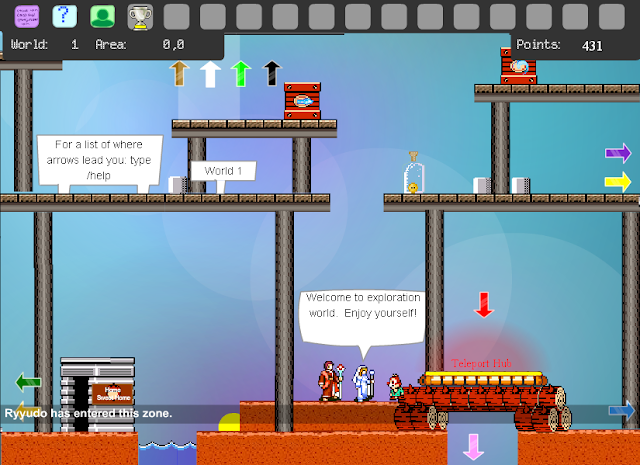
With no direct suggestion from the game itself at all, outside of a sign we both fail to read, we decide to go left.
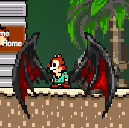
We get a jet pack in the form of giant demon wings and we're off to fly across this ledge... kinda. My wings fail me at first flap as I launch myself off the cliff, expecting to fly like an eagle. Instead, I plummet at the horrible frame rate this game runs at, and I die instantly by pitfall. Tim gets a pretty good laugh as I try again, successfully making it across.
We find a portal and activate it. After a 5 second countdown we're teleported to the Jungle.... which is apparently World 12?

We go right, and we're given a choice between holes to fall in. My gamer instinct kicks in and I know it's the hole that's farther away. I'm sure Tim knew too, but he missed the jump and landed in the first hole, dying, and now giving me a good laugh. On the next screen, we are now in a pool of what seems to be LCL.

We continue right, now in some "random shapes" zone, for lack of better way of explaining it. Each of the (seemingly randomly picked) yellow shapes, which look like they were made by some kid in MSPaint, is a spring. You jump on them, they make the "BOING" noise from Super Mario World, used mostly by the football enemies, and you go bouncing up... I wish I could say I was kidding.

Assuming down means death, like in most platformers, we clumsily bounce our way up to the top of the screen where the crates are. These crates are power-ups; weapons to use against enemies. I figure we'll need them, meaning there must be enemies going forward. With trying to go down seeming like a bad option, we just make a wild jump to the left. This leads to Purgatory.
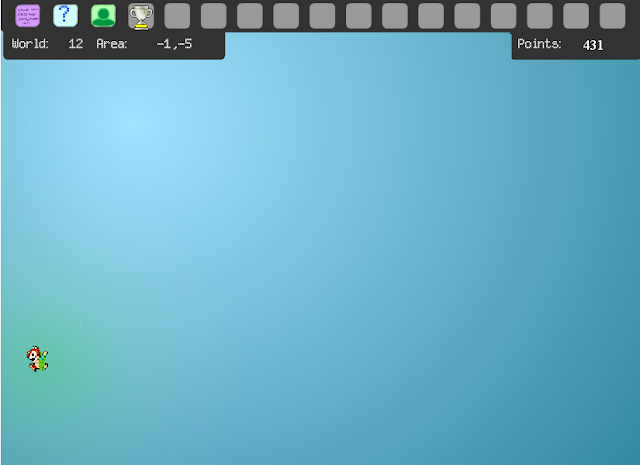
There're no enemies, no platforms, no nothing. All you got is yourself, massive DI and nowhere to go while you fall for about 10 seconds. Doesn't matter if you go left or right with that super DI. There's nothing there but wait until you eventually die. The game returns you back to your last save point after death: in this case, the little tree hut at the beginning of the jungle.
Well fuck going right, we're gonna go left! We're greeted with four platforms. One higher than the next, going left. Well we can totally make that. I mean, seriously, look at the maximum jumping height, and the height of the platform!


Tim also jumps, but no such luck. Also, the game announces to, what I assume is, the whole playerbase when someone dies. At the very least, everyone in the same world gets to see you fail constantly.
At this point, we're just Mexican Jumping Beans, popping up as much as we possibly can, but accomplishing nothing but minimal heights, spamming ourselves with "Ryyudo has died!" and "Timotee has died!"
Tim makes it to the first platform and waits for me. I falter and fail many a time. Tim then goes for the third, and fourth, making it just fine (screw you Tim). He mentions that a running start somehow gives you a few pixels more height of jump, or something. So I get some running start, and these jumps are still out of my reach.
I finally make it to the second platform, only to die while trying to get up to the 3rd. Fuck! After about a good 5 minutes of error after error, I make it up to the last platform, and the next area.

There's a tractor beam heading upward, and some arbitrary enemies below the platform we're on. I jump and get beamed up. Tim, on the other hand, decides to pass it up, or maybe missed his jump since the game doesn't track other players' movement very well. Either way, Tim heads downward. He then dies trying to get back up on top (I assume), since I only see the message from where I'm at. Tim has to go back to before the crazy high jumps. So I wait for him in the most dismal place so far. Ganondarf's Castle.

I assume it was an intentional typo... right? Tim makes it to the entrance of Ganondarf's Castle. We save in the house save point and begin to make our way up the tower by heading left.
The jumps on the first screen are pretty easy, and we climb up the tower with ease. But we get to the second screen, and the 3rd jump on the screen is out of reach. No matter how much of a running start we get (or anything else, for that matter) we can't make this jump!

Then I get an idea! Tim had killed me earlier by lifting me up and throwing me into a pit (fucker) and I figured, if I lift Tim up, I can throw him up top to the platform. Now we're thinking with portals!
Tim gets on that platform. From there he's able to make the next two jumps, then jumps up to the next map and dies almost instantly to a monster up there. We do this a few more times before Tim tosses me up to let me try. I then get another weird idea: I try to grab Tim while he jumps on top of the 2nd platform, which works! Now we're both up on these platforms!
At this point, some other guy in the game (and from what it seemed, the only other guy in the game, at the time.) Started talking to us, though he's in a different world. He seems like he's 13 or 14, speaking with extreme emotes @_@ <_< r_r (I dunno what that last one is supposed to be, but he used it) and "cutesy" words, like 'bish' and 'plz.'
He asks us to invite him to where we are. We do, and he makes it up to where we are with extreme ease. He's some kind of Pokemon (my Poke-knowledge is rusty,) and has like 10 jumps or something. Tim and I semi-ignore him and continue ascending the tower at our own pace, and I finally make it up top next. Then this guy jumps up, kidnaps me, and throws me into a monster. Obviously, I die. His goal becomes all too apparent: To sabotage and grief us as annoyingly (and as much) as possible.
So without any sort of sarcasm, bias, or anything, we can officially say that 1/3rd of the game's population are DICKS.
This guy flies/jumps away, types '*grabs sword*' and flies back to the screen Tim and I are still struggling with. The sword swings around his Pokemon like he was Mewtwo from Super Smash Bros. Melee, circling about him in some kind of unwieldy manner, stunning us every time we get hit with it (although while stunned, you can STILL pick up other players.) We're barely able to progress as this kid sits on top of the topmost platform saying "bring it on bish <_<"
Tim and I decide via Google Talk that we need to go to a different world. We warp away using a "/home" command that brings you back to the beginning of the game. The kid, on the other hand, still taunting us to come up "if we dare..." I say something to along the lines of "Do it!", although it's directed at Tim. The kid apparently takes that as a challenge, as his taunts continued. Hoo hoo hoo!
This time around, we go right from the very first screen. We pass the first screen with ease and reach the second screen, where there's a random boss by the name of Gargantio.

Tim gracefully jumps over the boss, whereas I gracefully put my furry nuts on the boss's face and die because of it. Tim jumps up to the top, and then jumps left onto of the logs, grabs the crate of acorns (what?) jumps back down, and defeats the boss like a complete badass. I grab the trophy the boss drops, which was rightfully Tim's, and we make our way right to the next screen. Another teleporter, another 5 second countdown, and we're in some sort of beach land. World 11 now...

We jump over Bomberman (he's an enemy for whatever reason,) and make our way through random stuff, jumping over some more Bombermans and finally arriving at another save point that's UNDER THA' SEA! Although the way I made it there was through a weird glitch where I fell into the water while standing on a piece of dry land. There was a random save point where I landed, even though it didn't seem like I was supposed to be there...

Tim and I meet up at the next save point, and continue right. The next part was... a strange test of physics and patience. Mostly patience as there seemed to be little physics to be found.

I could not, for the fucking life of me, figure out the physics (assuming there's any) behind these yellow bouncers. And neither could Tim. We bounced and bounced but the 4th one always fucked us over. We couldn't get enough height on a consistent basis to turn and make it to the 5th circle. I made it once. ONCE! And died from a random enemy when I reached the top and headed into the next screen.
Finally, Tim messages me on Gtalk:
Tim:no, this game sucks
Jamaal: Hilariously bad
Tim:I'm not gonna pretend it doesn't anymore
Bless Tim for his strength of mind. We stopped soon after, our mentalities unable to take any more abuse at the hands of this pre-alpha test game. The game has constant advertisements telling you to join the discussion on the board, and to add this game to your favorites if you enjoy it. Tim and I both agreed:
We'll just stick to the Flash Video, thanks. A minute long, and 20 times the entertainment.
Ch-Ch-Ch-Chip 'n Dales! With Extreme PvP!
You might be wondering why I'm quoting an old as hell flash movie. And if you're not, well... you should be! That video is why I'm writing this blog post. It's why I spent a day seeking adventure, seeing new worlds and new things with my buddy Tim, who accompanied me on this epic quest.
It all started yesterday (Friday) night when I remembered the old flash video "Chip 'n Dales M.M.O.R.P.G." Wanting to re-live the amusement of the song and video, I Google'd it up. Of course, it was my first find. The same one uploaded on AlbinoBlackSheep. Old School.
But what's this site Google searched up right below the flash video? No... you have to be kidding me!

"Chip and Dales" is one thing that can be taken the wrong way if found in your search history.
AN ACTUAL CHIP 'N DALES MMORPG
I admit, my curiosity spilled over like a boiling pot of soup. I had to see what this was about. I couldn't ASK questions, I just had to jump right in! But I knew I couldn't do this alone. I had to have someone with me, someone to experience what I experienced, so that others would believe what we saw.
My buddy Tim happened to be on, and therefore, I invited him to join me for some Chip 'n Dale chipmunk-y fun. The date was set: Saturday morning.
We register, select our characters (which actually spans over many characters, not just the chipmunk duo), and log in. There's no client to download; only a flash to load. Who knew what to expect at this point besides platforming madness? We go through the, deceptively, easygoing Tutorial. At least it doesn't seem too shabby... for a Flash game, at least.
Tim and I meet up outside the tutorial. I'm Dale, but only because you gotta unlock Chip. =/ Furthermore, the names between Chip and Dale are reversed in this game. Great editing fellas! Tim picks Kirby, one of his all-time favorite characters. There seems to be no difference in the characters' abilities, only the sprites themselves, with Dale getting his sprite from the NES C'nD game, and Kirby getting the one from Kirby Super Star. All right. On the first screen, we are given about, literally, 12 different options as to where to go, at least according to the arrows.


We find a portal and activate it. After a 5 second countdown we're teleported to the Jungle.... which is apparently World 12?

We go right, and we're given a choice between holes to fall in. My gamer instinct kicks in and I know it's the hole that's farther away. I'm sure Tim knew too, but he missed the jump and landed in the first hole, dying, and now giving me a good laugh. On the next screen, we are now in a pool of what seems to be LCL.

What if that's NOT LCL?
We continue right, now in some "random shapes" zone, for lack of better way of explaining it. Each of the (seemingly randomly picked) yellow shapes, which look like they were made by some kid in MSPaint, is a spring. You jump on them, they make the "BOING" noise from Super Mario World, used mostly by the football enemies, and you go bouncing up... I wish I could say I was kidding.

Assuming down means death, like in most platformers, we clumsily bounce our way up to the top of the screen where the crates are. These crates are power-ups; weapons to use against enemies. I figure we'll need them, meaning there must be enemies going forward. With trying to go down seeming like a bad option, we just make a wild jump to the left. This leads to Purgatory.

There're no enemies, no platforms, no nothing. All you got is yourself, massive DI and nowhere to go while you fall for about 10 seconds. Doesn't matter if you go left or right with that super DI. There's nothing there but wait until you eventually die. The game returns you back to your last save point after death: in this case, the little tree hut at the beginning of the jungle.
Well fuck going right, we're gonna go left! We're greeted with four platforms. One higher than the next, going left. Well we can totally make that. I mean, seriously, look at the maximum jumping height, and the height of the platform!

I can totally make that, right?

FUCK!
Tim also jumps, but no such luck. Also, the game announces to, what I assume is, the whole playerbase when someone dies. At the very least, everyone in the same world gets to see you fail constantly.
At this point, we're just Mexican Jumping Beans, popping up as much as we possibly can, but accomplishing nothing but minimal heights, spamming ourselves with "Ryyudo has died!" and "Timotee has died!"
Tim makes it to the first platform and waits for me. I falter and fail many a time. Tim then goes for the third, and fourth, making it just fine (screw you Tim). He mentions that a running start somehow gives you a few pixels more height of jump, or something. So I get some running start, and these jumps are still out of my reach.
I finally make it to the second platform, only to die while trying to get up to the 3rd. Fuck! After about a good 5 minutes of error after error, I make it up to the last platform, and the next area.

I died this much AFTER getting a knack for the game and going back to take pictures for this entry.
There's a tractor beam heading upward, and some arbitrary enemies below the platform we're on. I jump and get beamed up. Tim, on the other hand, decides to pass it up, or maybe missed his jump since the game doesn't track other players' movement very well. Either way, Tim heads downward. He then dies trying to get back up on top (I assume), since I only see the message from where I'm at. Tim has to go back to before the crazy high jumps. So I wait for him in the most dismal place so far. Ganondarf's Castle.

Ganondarf is probably a pretty nice guy.
I assume it was an intentional typo... right? Tim makes it to the entrance of Ganondarf's Castle. We save in the house save point and begin to make our way up the tower by heading left.
The jumps on the first screen are pretty easy, and we climb up the tower with ease. But we get to the second screen, and the 3rd jump on the screen is out of reach. No matter how much of a running start we get (or anything else, for that matter) we can't make this jump!

Actually, after I took this picture, I somehow managed to clip my guy up there for a split second.
Then I get an idea! Tim had killed me earlier by lifting me up and throwing me into a pit (fucker) and I figured, if I lift Tim up, I can throw him up top to the platform. Now we're thinking with portals!
Tim gets on that platform. From there he's able to make the next two jumps, then jumps up to the next map and dies almost instantly to a monster up there. We do this a few more times before Tim tosses me up to let me try. I then get another weird idea: I try to grab Tim while he jumps on top of the 2nd platform, which works! Now we're both up on these platforms!
At this point, some other guy in the game (and from what it seemed, the only other guy in the game, at the time.) Started talking to us, though he's in a different world. He seems like he's 13 or 14, speaking with extreme emotes @_@ <_< r_r (I dunno what that last one is supposed to be, but he used it) and "cutesy" words, like 'bish' and 'plz.'
He asks us to invite him to where we are. We do, and he makes it up to where we are with extreme ease. He's some kind of Pokemon (my Poke-knowledge is rusty,) and has like 10 jumps or something. Tim and I semi-ignore him and continue ascending the tower at our own pace, and I finally make it up top next. Then this guy jumps up, kidnaps me, and throws me into a monster. Obviously, I die. His goal becomes all too apparent: To sabotage and grief us as annoyingly (and as much) as possible.
So without any sort of sarcasm, bias, or anything, we can officially say that 1/3rd of the game's population are DICKS.
This guy flies/jumps away, types '*grabs sword*' and flies back to the screen Tim and I are still struggling with. The sword swings around his Pokemon like he was Mewtwo from Super Smash Bros. Melee, circling about him in some kind of unwieldy manner, stunning us every time we get hit with it (although while stunned, you can STILL pick up other players.) We're barely able to progress as this kid sits on top of the topmost platform saying "bring it on bish <_<"
Tim and I decide via Google Talk that we need to go to a different world. We warp away using a "/home" command that brings you back to the beginning of the game. The kid, on the other hand, still taunting us to come up "if we dare..." I say something to along the lines of "Do it!", although it's directed at Tim. The kid apparently takes that as a challenge, as his taunts continued. Hoo hoo hoo!
This time around, we go right from the very first screen. We pass the first screen with ease and reach the second screen, where there's a random boss by the name of Gargantio.

Tim gracefully jumps over the boss, whereas I gracefully put my furry nuts on the boss's face and die because of it. Tim jumps up to the top, and then jumps left onto of the logs, grabs the crate of acorns (what?) jumps back down, and defeats the boss like a complete badass. I grab the trophy the boss drops, which was rightfully Tim's, and we make our way right to the next screen. Another teleporter, another 5 second countdown, and we're in some sort of beach land. World 11 now...

We jump over Bomberman (he's an enemy for whatever reason,) and make our way through random stuff, jumping over some more Bombermans and finally arriving at another save point that's UNDER THA' SEA! Although the way I made it there was through a weird glitch where I fell into the water while standing on a piece of dry land. There was a random save point where I landed, even though it didn't seem like I was supposed to be there...

I was able to get back down there. Honestly, all the land-pillars weren't down here earlier today. They completely revamped this world, for the better, throughout the day. Also, it seems OTHER people are playing this game. Seriously?
Tim and I meet up at the next save point, and continue right. The next part was... a strange test of physics and patience. Mostly patience as there seemed to be little physics to be found.

Earlier today, the grey blocks weren't there. They were just randomly floating yellow balls.
I could not, for the fucking life of me, figure out the physics (assuming there's any) behind these yellow bouncers. And neither could Tim. We bounced and bounced but the 4th one always fucked us over. We couldn't get enough height on a consistent basis to turn and make it to the 5th circle. I made it once. ONCE! And died from a random enemy when I reached the top and headed into the next screen.
Finally, Tim messages me on Gtalk:
Tim:no, this game sucks
Jamaal: Hilariously bad
Tim:I'm not gonna pretend it doesn't anymore
Bless Tim for his strength of mind. We stopped soon after, our mentalities unable to take any more abuse at the hands of this pre-alpha test game. The game has constant advertisements telling you to join the discussion on the board, and to add this game to your favorites if you enjoy it. Tim and I both agreed:
There is NOTHING to enjoy here.
We'll just stick to the Flash Video, thanks. A minute long, and 20 times the entertainment.
Sunday, November 22, 2009
Konami Sure Seems To Hate You, Pop'n Music Fans
Being a fan of Konami's music games outside of Japanese arcades means engaging in a bipolar relationship with a monstrous corporation that probably hates you (this is ignoring the act of playing the games themselves, which is perhaps just as devastating). Ain't no better example of what I'm talking about than the plight Pop'n Music fans have had to endure over the past few years.
Yes, Pop'n Music. Think of it as Beatmania IIDX's slightly less hateful, significantly more colorful sibling, with a broader taste in music and a learning curve that assumes you haven't already been playing the game for 10 years (note: you might want to read that article I wrote about IIDX a year ago; the terminology in there gets reused a lot). There's a guy on youtube who uploads autoplay videos of easy songs, too? Well, there you go. Here's a video of one of the hardest songs in the game, just to even things out.
The big difference between Pop'n Music and IIDX is, as you've probably guessed, the method of input. IIDX is played with that bizarre turntable-piano-monster thing, while Pop'n has an array of 9 gigantic UFO-catcher giga buttons, each capable of generating a sound louder than a violently convulsing washing machine. There's no way to adjust the scroll speed of the notes on a per-pixel basis like in IIDX, and there are far more excruciating mindfuck songs with insane speed changes, so folks tend to play at even faster Hi-Speeds than in IIDX. S-Random is a lot more popular than Random for whatever reason, and it's here that you actually end up having to use your arms and elbows to hit certain crazy note combinations that only show up when everything gets thrown in the blender.
There are also ojama (literal translation: annoying bullshit) which range from scoring goals to bizarre, Mario Kart-style disruptions of gameplay where your notes fall at the wrong speed, spin violently, or become blocked out completely by god knows what. These are all optional, and can be turned on before any song at your discretion. The harder/more insane the ojama, the more "challenge points" you earn. More challenge points means a greater chance of getting the extra stage in the arcades. Really, though, most people just turn 'em on for fun.
Obviously, I could write an article about this game all day. I shouldn't, though. This is supposed to be about how Konami keeps screwing over Pop'n Music's console audience. So let's talk about that!
Exhibit A: Konami has released 17 mainline arcade installments of the game, with the most recent being Pop'n Music 17 THE MOVIE (like IIDX, the "theme" of each game has almost zero bearing on the actual music in the game, outside of one or two songs). The latest version of the game on console? Pop'n Music 14 FEVER. Initially, folks just assumed Konami was biding their time before releasing the best console port ever, but after nearly 3 years it's all but assumed that Konami's never doing another one of these games on the PS2. This was already a pretty big slap in the face to people who had shelled out crazy money for an arcade-style pop'n controller. It gets worse, though!
Exhibit B: Beat'n Groovy. Oh my god. What do I even say about this thing? It stems from the same proud tradition that brought us the North American release of beatmania and Rock Revolution. It's an Xbox Live Arcade game, which means that in addition to the embarrassing graphic design and busted play mechanics, there are also only nine songs in the game. Based on the online leaderboards, about 7,000 people bought the game. I can never figure out why Konami keeps making stuff like this, but everyone involved should probably be ashamed. Thankfully, it doesn't really get worse from here. Sorta.
Exhibit C: Pop'n Music Wii. A standalone "reboot" of the franchise which replaces the game's original extremely satisfying visceral button-smashing controls with awful wiimote gestures. It bombed in Japan. In North America, it just got a stealthy release with no fanfare. We're talkin' so stealthy that not even bemanistyle knew it was coming out. When your obsessed, hardcore target audience doesn't even know your game is out, something is wrong.
Clearly, Konami doesn't really seem to give a shit. Unfortunately, they recently announced Exhibit D, Pop'n Music Portable, in which they reveal, horrifyingly, that they kinda do. Here, at last, is the port of Pop'n Music Adventure that fans were clamoring for, but it's on the PSP. The control scheme looks unplayable: you can play Pop'n on a dualshock, sure, but that thing's got four shoulder buttons to the PSP's two. Who are they making this game for? It looks like they put some effort into it. Why not just release a PS2 version? Has that ship sailed? Gosh, it all feels so inexplicable!
In conclusion: yeah, hey, whatever you want Konami. We'll see when it comes out.
Yes, Pop'n Music. Think of it as Beatmania IIDX's slightly less hateful, significantly more colorful sibling, with a broader taste in music and a learning curve that assumes you haven't already been playing the game for 10 years (note: you might want to read that article I wrote about IIDX a year ago; the terminology in there gets reused a lot). There's a guy on youtube who uploads autoplay videos of easy songs, too? Well, there you go. Here's a video of one of the hardest songs in the game, just to even things out.
The big difference between Pop'n Music and IIDX is, as you've probably guessed, the method of input. IIDX is played with that bizarre turntable-piano-monster thing, while Pop'n has an array of 9 gigantic UFO-catcher giga buttons, each capable of generating a sound louder than a violently convulsing washing machine. There's no way to adjust the scroll speed of the notes on a per-pixel basis like in IIDX, and there are far more excruciating mindfuck songs with insane speed changes, so folks tend to play at even faster Hi-Speeds than in IIDX. S-Random is a lot more popular than Random for whatever reason, and it's here that you actually end up having to use your arms and elbows to hit certain crazy note combinations that only show up when everything gets thrown in the blender.
There are also ojama (literal translation: annoying bullshit) which range from scoring goals to bizarre, Mario Kart-style disruptions of gameplay where your notes fall at the wrong speed, spin violently, or become blocked out completely by god knows what. These are all optional, and can be turned on before any song at your discretion. The harder/more insane the ojama, the more "challenge points" you earn. More challenge points means a greater chance of getting the extra stage in the arcades. Really, though, most people just turn 'em on for fun.
Obviously, I could write an article about this game all day. I shouldn't, though. This is supposed to be about how Konami keeps screwing over Pop'n Music's console audience. So let's talk about that!
Exhibit A: Konami has released 17 mainline arcade installments of the game, with the most recent being Pop'n Music 17 THE MOVIE (like IIDX, the "theme" of each game has almost zero bearing on the actual music in the game, outside of one or two songs). The latest version of the game on console? Pop'n Music 14 FEVER. Initially, folks just assumed Konami was biding their time before releasing the best console port ever, but after nearly 3 years it's all but assumed that Konami's never doing another one of these games on the PS2. This was already a pretty big slap in the face to people who had shelled out crazy money for an arcade-style pop'n controller. It gets worse, though!
Exhibit B: Beat'n Groovy. Oh my god. What do I even say about this thing? It stems from the same proud tradition that brought us the North American release of beatmania and Rock Revolution. It's an Xbox Live Arcade game, which means that in addition to the embarrassing graphic design and busted play mechanics, there are also only nine songs in the game. Based on the online leaderboards, about 7,000 people bought the game. I can never figure out why Konami keeps making stuff like this, but everyone involved should probably be ashamed. Thankfully, it doesn't really get worse from here. Sorta.
Exhibit C: Pop'n Music Wii. A standalone "reboot" of the franchise which replaces the game's original extremely satisfying visceral button-smashing controls with awful wiimote gestures. It bombed in Japan. In North America, it just got a stealthy release with no fanfare. We're talkin' so stealthy that not even bemanistyle knew it was coming out. When your obsessed, hardcore target audience doesn't even know your game is out, something is wrong.
Clearly, Konami doesn't really seem to give a shit. Unfortunately, they recently announced Exhibit D, Pop'n Music Portable, in which they reveal, horrifyingly, that they kinda do. Here, at last, is the port of Pop'n Music Adventure that fans were clamoring for, but it's on the PSP. The control scheme looks unplayable: you can play Pop'n on a dualshock, sure, but that thing's got four shoulder buttons to the PSP's two. Who are they making this game for? It looks like they put some effort into it. Why not just release a PS2 version? Has that ship sailed? Gosh, it all feels so inexplicable!
In conclusion: yeah, hey, whatever you want Konami. We'll see when it comes out.
Thursday, November 19, 2009
The Name Was Originally Going to Be "Masturbearding"
 Occasionally terrifying but often interesting video game forum selectbutton now has a podcast! Every episode is edited by a professional audio engineer, so it sounds pretty decent for a show conducted via Ventrilo, of all things.
I was in episode 2, which covered fighting games in a less-accessible way than I would have liked (there is some irony in there, I'm sure), and episode 3, which was marred by technical difficulties and a questionable choice of topic.
Episode 4 (subject: the treatment of video games in other media) features the guy who made the smmooooothest Let's Play video ever made as host, along with a really well-researched and coherent discussion from all the guests. Good place to start listenin', I'd say.
The show's also on itunes, and I'll be sure to make a post or two here when I show up in future episodes.
Tuesday, October 27, 2009
Boy, Nintendo never cared about Virtual Console, huh
I've been retranslating the credits for Super Robot Wars J this past evening (one of the side effects of having a Brazilian non-native English/Japanese speaker translate a game: he gets lots of things wrong that you have to correct later. The credits are just one element of many - and yeah I plan on writing more about the game at some point, sit tight). As a result, I've been stumblin' onto all sorts 'o wacky web pages for subcontractors involved in the game's development at some level or another.
Qwintet, for example. Who are these guys? I thought they were Quintet at first. They were apparently responsible for SRWJ's loathsome sound design.
And Ancient! I don't pay much attention to what those guys are up to these days, but they've got a link to Streets of Rage 2 on their page, at least. That's reassuring. The link is actually to Sega's Japanese Virtual Console page, which is pretty dang remarkable. Every game has its own video, along with detailed information, character artwork and so on. I'm a little blown away at how nice this site is, actually.
Point is, the videos they made for these games are really something compared to the equivalent videos on Nintendo of America's Virtual Console page. Check out the one for Shinobi III! Shit, that is some classy video editing. Sync's up with the music from the intro, and it shows off everything cool about the game in about a minute or two.
Compare that to Nintendo of America's version. I think it speaks for itself. NOA clearly never gave a shit and whoever's handling Sega's Japanese VC page clearly does, but yeah, this is all pretty obvious. I mostly just wanted an excuse to link to Sega's classy virtual console page, maybe inspire somebody to go out there and play some awesome Genesis games. With that in mind, some favorites:
Qwintet, for example. Who are these guys? I thought they were Quintet at first. They were apparently responsible for SRWJ's loathsome sound design.
And Ancient! I don't pay much attention to what those guys are up to these days, but they've got a link to Streets of Rage 2 on their page, at least. That's reassuring. The link is actually to Sega's Japanese Virtual Console page, which is pretty dang remarkable. Every game has its own video, along with detailed information, character artwork and so on. I'm a little blown away at how nice this site is, actually.
Point is, the videos they made for these games are really something compared to the equivalent videos on Nintendo of America's Virtual Console page. Check out the one for Shinobi III! Shit, that is some classy video editing. Sync's up with the music from the intro, and it shows off everything cool about the game in about a minute or two.
Compare that to Nintendo of America's version. I think it speaks for itself. NOA clearly never gave a shit and whoever's handling Sega's Japanese VC page clearly does, but yeah, this is all pretty obvious. I mostly just wanted an excuse to link to Sega's classy virtual console page, maybe inspire somebody to go out there and play some awesome Genesis games. With that in mind, some favorites:
- Alien Soldier's video smartly doubles as a tutorial on how to beat the game's towering, gently pulsating mountain of gross boss monsters. That is to say: make sure you're at full health, and then do that awesome zero dash thing that does like a million damage. You're a pro already! It also has a clip of the game's most important moment. See if you can spot it. I played through this game recently with some friends just to see it, so you're saving some time here (HINT: it might remind you a little of Altered Beast).
- Shadow Dancer is apparently still not available for purchase from the US virtual console. I want to say that it's because of the twin towers on the title screen, but Vigilante has those too, so I'm gonna shrug my shoulders on this one. Shadow Dancer has really chunky, heavy music that goes down like a big bowl of soup, ninjas jumping down from scaffolding on the Statue of Liberty, a dog you can sic on enemies, one-hit deaths, and a bonus stage where you jump off a building because that's what ninjas do and throw shuriken at dudes on the way down. It's the Genesis' Ninja Spirit equivalent, and you should ninja get it.
- This is going to put me in the unfortunate company of the slightly insane Dave Halverson, but I fucking love Dynamite Headdy. Like, a lot. The backgrounds alone, man! Headdy's driving concept is that it takes place in a puppet theatre, which means that everything's a prop, and the whole place is barely holding together under the workmanship of a very hardworking and tired group of (entirely unseen) human beings. You're never explicitly told any of this by the game, but the game pulls off its aesthetic vision with such confidence that you can't not figure it out. The game slingshots from one idea to the next with Treasure's usual ebullience, enough to almost make you not care about what a giant punch in the face the final boss is.
- I've written about Toe Jam & Earl before, but it bears repeating.
- Musha Aleste (known in the west as M.U.S.H.A.) sums up Compile's design ethos in one game. 8-minute long stages. Power-ups that render you as a god. Enemies barely capable of firing at you. On default settings, Musha Aleste has a breezy quality to it that folks weened on modern arcade shooting games might find quaint or hilarious. That's just the way console shooting games were back then! Hudson Soft was king of the pack, and shooting things without fear of reprisal under the stern guidance of Master Takahashi's violently vibrating index finger was the de facto design standard. And of course: the noisy FM metal soundtrack and steampunk-meets-sengoku era setting. Can't forget those.
Subscribe to:
Posts (Atom)